We tend to stereotype celebrities as people who dropped out of school early to pursue their career. When they achieve some fame, they will be so busy that they won't have time to go back to studies or pursue a business for that matter.
I was surprised to learnt that well-known TV host in Singapore - Pornsak - came to Singapore as a child speaking only Thai. Now he speaks Mandarin and English more fluently than most of us Singaporeans. On top of that he has got not just 1 but 3 degrees (2 Bachelors and 1 Masters) under his belt.
Besides that, he also runs a successful Thai restaurant chain and an child education centre in Singapore.
That's despite we see him every other day hosting some programme on TV and with a couple of TV host awards under his belt as well! He must be raking in good bucks with all that ad endorsements as well.
The really important exams are in primary 2, primary 4 and primary 6. For the rest of the exams, we can use them to experiment with study process, let the kid experience some form of failure etc.
Good assessment books
Andrew Er Maths
Dr Seuss's alphabet computer games
Model Chinese compo from China PSLE equivalent
Step-by-step Math Practice Book by Simon Eio (easy)
Visible thinking by Ammiel Wan
Motivation Strategies
Structured choices - This is a 101 strategy for handling kids. Give them choices that are safe. Trains their decision making muscle under safe circumstances.

Focus on Process, Not Grades - I believe this is the key strategy. Breaking down the study process into steps simple enough for autonomous execution and tracking. Use assessment books that kids themselves can validate their answers against. Encourage them to execute the steps habitually. Praise randomly, intermittently and variably to further encourage desirable behaviour. Relief parents of monitoring tasks. Teaching the kids to be independent. I like how the below sample process is separated into learning stage and exam preparation stage as the exam date draws near.


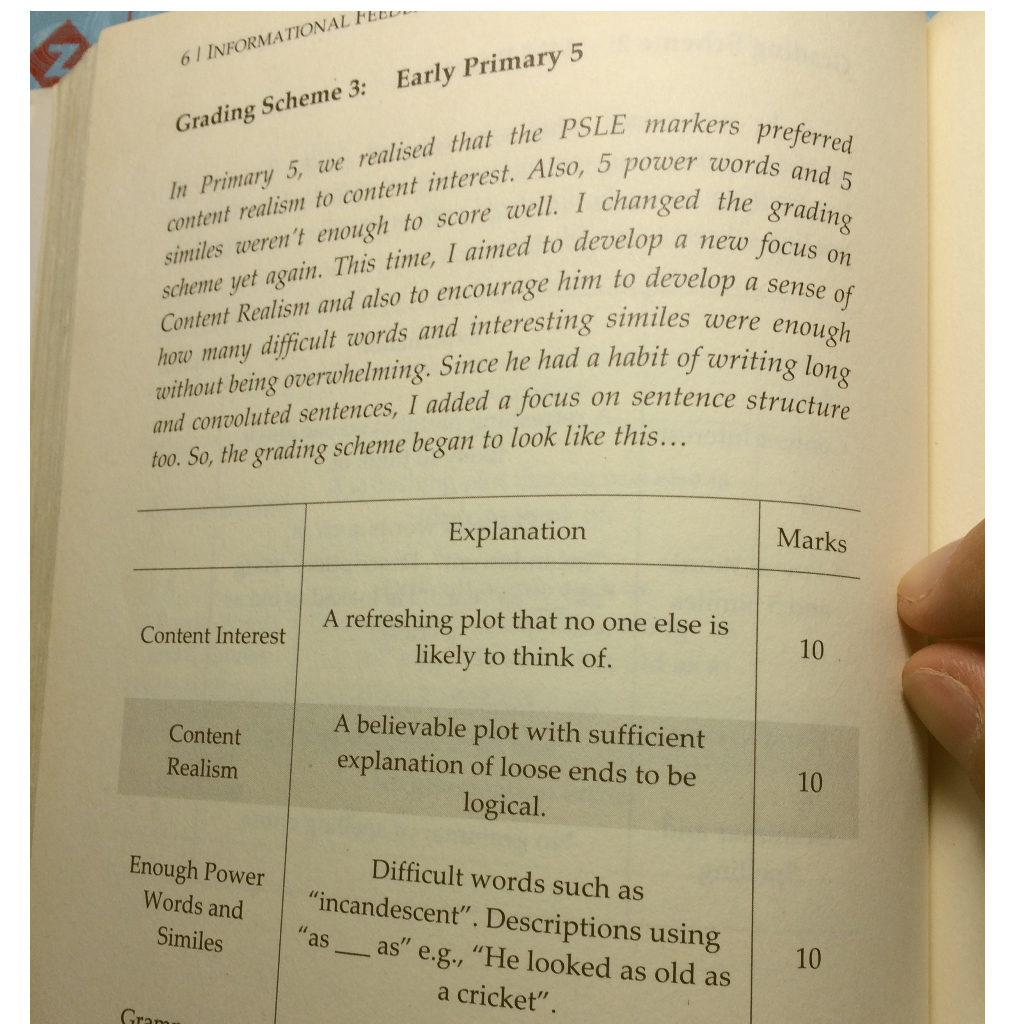
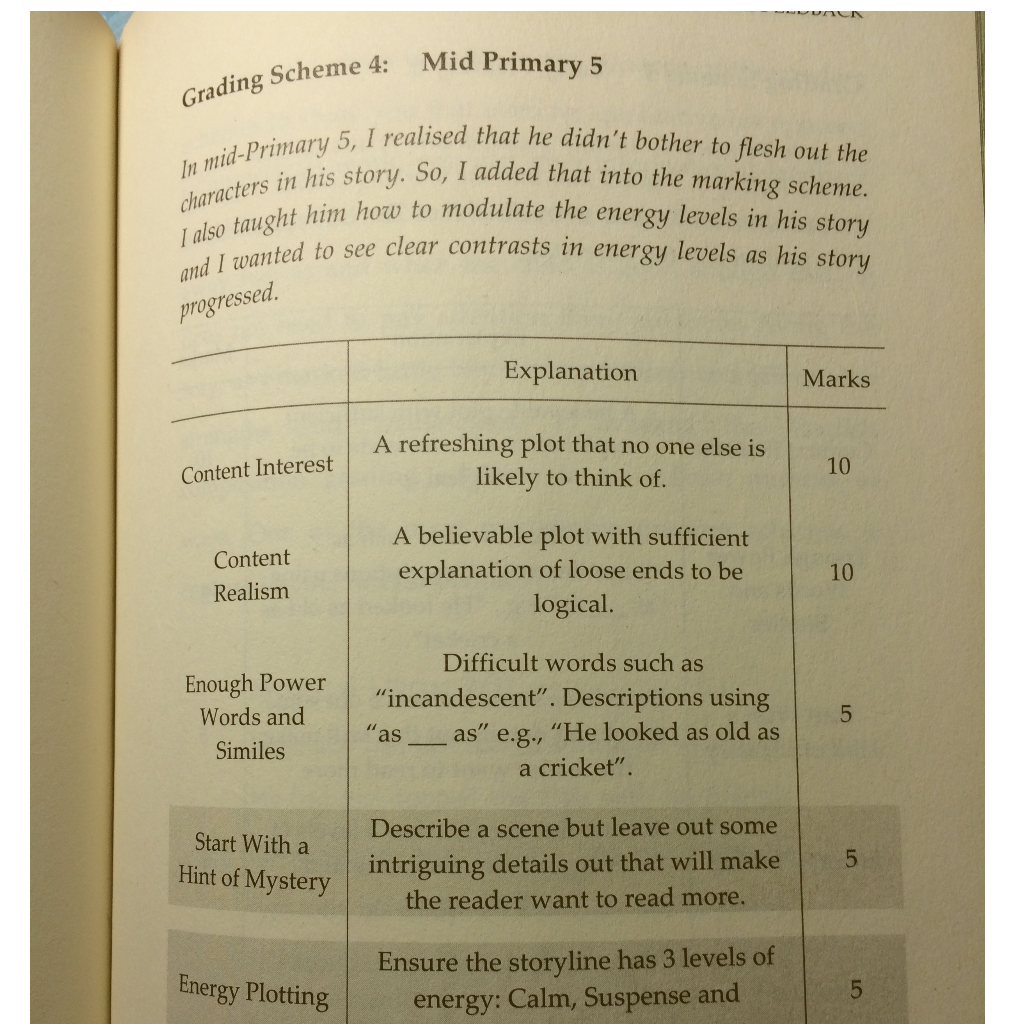
Informational Feedback - My key takeaway for this strategy is the way the author attempts to grade her kid's composition. We know the way to grade maths. You either get the question correct or wrong. Language is more subjective. The author provides a good framework that can be understood by the kid easily and simple for parents as well.


Difficult Victories - Letting the kid experiencing success that is hard to come by. Boosting his self confidence and crushing any limiting belief that he may have. Problem is how to create opportunities for him to experience such victories.
Emotional Connection - This is a given. Nagging is not going to work in the long run.
Random Intermittent Variable Reinforcements, Random Intermittent Variable Punishments - Similar to allowing kids to experience difficult victories, allowing situation to punish the kids. Let them learn from life lessons.
Failure Management - Shaping the kids to have learning goal orientation. A learning approach that strives to develop one's skills and abilities and not fearing to make mistakes, rather, learn and overcome mistakes.
Design Self Concept - This is basically about building up self esteem and self confidence.
Set Goals - I have questions on this. Do we only use marks for this? I am trying to not emphasise on marks to foster the learner's mindset mentioned in the earlier chapter.
Specify and Magnify - Basically, to notice the small good behaviours and praise in a big way.
Physical Movement - Children need to move around and stay active. Helps in their learning as well.
Images from book "Internal Drive Theory" by Petunia Lee.
Another good TV show I caught recently is this one which ask a celebrity to stand in for a blue collar worker's job for a day. In this episode, Pornsak took over the job over a worker from China who works with mobile toilets. It was tough. Day in day out for eight years, he has to clean foul-smelling toilets of human faeces and urination. The worker remembered that he could not get use to it in the beginning. In fact, his family back in China doesn't know the nature of his job. He didn't tell because he was afraid he may be despised by his family. He can only fly back and visit his family once every year. He didn't even make it back when his father passed away. He spent close to 10 years of his life working in Singapore away from his family. On one hand there is pain from this separation, on the other there is this unglamourous and tough job that adds on to the pain. What a sacrifice!
A meaningful show in which the TV hosts create a magical experience for the less fortunate. I sympathise with the beneficiaries. At the same time, I admire the resilience they show towards life, giving their utmost to care for their love ones. The future may be bleak. I am not sure how the children can take care of themselves in the future, especially when the parents are no longer around. The parents still shower their children with love, living each day as it comes, with hopes of a better tomorrow. The show reminds us how fortunate we are and to look beyond our problems at work. Work problems really pale in comparison with life challenges. We have to learn to appreciate our good health (and keep it that way) and our family.
Wow! A remarkable Singaporean! He picked up running at 54 years old and his goal is to complete 100 marathons! Since then, he has been running marathons in the home country and outside of the home country as well, like Berlin and Mongolia. He completed his 100th marathon in 2014 at the age of 84. Hard to imagine he used to be a heavy drinker, smoker and party-goer. He even contracted prostrate cancer at 75 and recovered from it. He continued running.
One of the reasons why he chose to change his lifestyle was to not be a burden to his children when he is old. Age is really a number. Stop giving ourselves excuses and get our butt out there!
Teresa Hsu (7 July 1898 – 7 December 2011) started to do social work in her forties and continued to help and care for the poor and the aged sick well into the final days of her life. She started Home for the Aged Sick and Heart to Heart Service in Singapore, relentlessly offering help to those in need. She was still actively involved in charity work after turning 110. I admire her charitable work and contribution to the society. I also admire her: Tireless Learning She was illiterate at 27. One day, she barged into a church begging the nuns to let her study. In exchange, she offered to do chores for them. And so, she started primary education at the age of 27. She picked up yoga at 69 years old! She went on to teach yoga to the young and old at temples, associations, hospitals and schools. Minimal Living Her clothes were either given to her or picked up from rubbish bins. She is a vegetarian and she ate simply. Her breakfast was a glass of water or milk. Lunch was often milk and salad, and it was milk or yogurt for dinner. She also maintained her mental well-being by practising yoga and staying optimistic.
I prefer to laugh than to weep. Those people who cry to me, I always tell them it is better to laugh than to use tissue paper, as laughing is free but tissue paper still cost five-cent. 'Ha ha ha' cost no cents.
He is passionate about Singapore, I guess more than the majority of us. The irony is, he has given up on Singapore. He said that he does not have any expectations, so that he will not be further disappointed. He did magnificent things around the world - architectural projects in Johor, built an high efficiency airplane - which he believed cannot be achieved in Singapore. Why?
Education System
He shared a case of his friend who is a dyslexic turned down by schools in Singapore but became high achiever and serial inventor overseas. Some how I got the hunch from watching biographies and documentaries that the "good" education systems will churn out a higher percentage of smart people. However, it does not tolerate erratic behaviours and it does not allow students to choose their area of focus and interest from early age. This is important accordingly to Malcolm Gladwell. We take 10,000 hours or the equivalent of 10 years to be an expert in any field. That's why most entrepreneurs are drop-outs. However, if education systems were to allow such flexibility, will it turn out that many will drop out and out? As in, they won't have a future at all? Oh by the way, studies show that dyslexics can be very intelligent, often out-of-the box thinkers and problem-solvers. Here are some big names in business who are dyslexic.
No Margin for Error
He shared that he went to the Economic Development Board (EDB) to propose building a solar energy-powered transportation for use within the school campus. EDB asked if the idea had been implemented in other countries before and if not, it could not be done in Singapore. I still remember the Hippo open air double bus took 6 months before getting an approval to run on Singapore roads. The Duck Tour (amphibious transportation) took 2 years. I saw many open places in parks and asked National Parks if I can operate children rides there. They gave me thousand and one restrictions. Is it true that we really cannot afford to fail in Singapore?
I had mixed feelings but felt a huge sense of loss. I first read about him in Secondary school history books. I was confused then. I anticipated a straightforward and sensational heroic story like how he led Singapore to her independence. I was a tat disappointed that he didn't really lead Singapore to her independence. He wanted Singapore to join Malaysia. Malaysia wanted Singapore out and that was how we got our independence. Well, nothing fanciful. I didn't understand then why he shed tears on National TV. Growing up, I heard mostly complaints about the Government and didn't really pay much attention to what went on. I was busy with my own life. When he spoke during National Rallies or during General Elections, the natural thing to do was to switch to other TV channels and grumble about how they had affected the normal TV schedules. When serving National Service, I hated the fact that I had to waste two and a half years of my life in the army and start University later. My only impression of him and the Government led by him was they were heavy handed. They asked us to speak English and also Chinese, stop chewing chewing gums, stop littering and stop at two kids. We had to abide or else be punished. Simple as that. I slowly start to appreciate what he and his Government have done for us, more so after I have children of my own. He curated the environment for a high literacy Singapore. Though both my parents are not highly educated, I could get my degree. He pushed for an economy that grew at an blazing speed so that I could find a job, set up my own family, have children and could provide for my family comfortably. Thanks to his housing policy, I realised that my parents, though not well-to-do, could afford their own house. I could own my own house right after I got married and sold for a profit later. He curated a safe Singapore which we could come back home late at night safely and my children could come back from school on their own. Above all, he ensured that Singapore survived after our separation from the British and Malaysia. If not, there wouldn't have been Singapore today and likely there wouldn't be me. As I watched condolences for him splashed all over TV and social media, I wished we had told him in person. Perhaps he would have felt more satisfied and accomplished that he had made a difference to many. Or perhaps it doesn't matter because from what I read about him. He didn't not really care what others thought about him. He only did what he felt was correct. I always think it is strange that we honor people only after their passing. For some reason, this is just how human works. Nonetheless, sights of people weeping and tributes from world leaders as well as people from all walks of life have made me feel that the country has united like I have never felt before. Look no further, we have our very own hero right here in our own backyard. He spent his entire life tenaciously realising his vision for the nation. All done in one lifetime, his lifetime. His legacy is left for us to enjoy, protect and continue to build upon. These few days as I send my kids to school, I am more aware and more appreciative of the surrounding . The well-lit pavements and roads donned with greeneries, the well-equipped school, the safe environment for the kids to grow up in, the nicely-done-up exercising corners that senior citizens are working out at, the air-conditioned buses and MRTs...There couldn't have been a better place to grow up in and it couldn't have existed without Mr Lee Kuan Yew.
Just attended my girl's parent-teacher meeting. The Chinese teacher was pretty pragmatic. She said if she put Chinese spelling on Mondays, no one will study for it. She will try to give Chinese homework on Friday so that students have the weekends to complete them. Some parents during the meeting were concerned about percentage of marks for exams and exam topics. Since when we have degenerated to be like this. Our kids are not in school to learn anymore. They are there to learn to take exams. I asked a couple of parents how to keep our kids curious and interested in learning as they move up the ranks. They said, "No choice...". They will be overwhelmed by homework and exams. Sad...
 We tend to stereotype celebrities as people who dropped out of school early to pursue their career. When they achieve some fame, they will be so busy that they won't have time to go back to studies or pursue a business for that matter.