Showing posts with label book notes. Show all posts

Apr 12, 2016

Book Notes: The Paradox of Choice Why Less is More by Barry Schwartz

Peak-end rule: "what we remember about the pleasurable quality of our past experiences is almost entirely determined by two things: how the experiences felt when they were at their peak (best or worst), and how they felt when they ended."

No doubt we have more access to information, especially from the Internet, to make decisions from. But because of clever advertising and marketing, we may be blinded. Humans also have certain psychological quirks that prevent us from making sense of information objectively eg, aversion to loss.

Maximisers vs Satisficers - Maximisers are less satisfied.

The main portion of the book discusses why we suffer when making decisions. They are interesting for us to understand ourselves better. The last chapter of the book sums up with actionable steps that we could take to make our lives easier:

What to Do About Choice

  1. Choose When to Choose. “Two options is my limit” rule - visit no more than two stores when shopping for clothing or to consider no more than two locations when planning a vacation.
  2. Be a Chooser, Not a Picker. Choosers have the time to modify their goals; pickers do not. Choosers have the time to avoid following the herd; pickers do not. Good decisions take time and attention, and the only way we can find the needed time and attention is by choosing our spots.
  3. Satisfice More and Maximize Less. Knowing what is "good enough".
  4. Think About the Opportunity Costs of Opportunity Costs. Strategies to avoid the disappointment that comes from thinking about opportunity costs:
    1. Unless you’re truly dissatisfied, stick with what you always buy.
    2. Don’t be tempted by “new and improved.”
    3. Don’t “scratch” unless there’s an “itch.”
    4. And don’t worry that if you do this, you’ll miss out on all the new things the world has to offer.
  5. Make Your Decisions Nonreversible
  6. Practice an “Attitude of Gratitude”
  7. Regret Less. Mitigate regret by
    1. Adopting the standards of a satisficer rather than a maximizer.
    2. Reducing the number of options we consider before
    3. making a decision.
    4. Practicing gratitude for what is good in a decision rather than focusing on our disappointments with what is bad.
  8. Anticipate Adaptation. To be better prepared for, and less disappointed by adaptation:
    1. As you buy your new car, acknowledge that the thrill won’t be quite the same two months after you own it.
    2. Spend less time looking for the perfect thing (maximizing), so that you won’t have huge search costs to be “amortized” against the satisfaction you derive from what you actually choose.
    3. Remind yourself of how good things actually are instead of focusing on how they’re less good than they were at first.
  9. Control Expectation. To make the task of lowering expectations easier:
    1. Reduce the number of options you consider.
    2. Be a satisficer rather than a maximizer.
    3. Allow for serendipity.
  10. Curtail Social Comparison:
    1. Remember that “He who dies with the most toys wins” is a bumper sticker, not wisdom.
    2. Focus on what makes you happy, and what gives meaning to your life.
  11. Learn to Love Constraints

Nov 26, 2015

Book Notes: A Gift to My Children by Jim Rogers


A nice easy read written by Jim Rogers to his 2 children. Much of the wisdom is what we wish for our own children.

My key takeaways from this book:
  • Think for yourself and don't be affect by others' opinion. It is ok to be different. Think different. Do not seek to follow the crowd. The news may not be true, even history books may not be all true. Do your own homework. Be hardworking. Be confident.
  • Jim got me interested in studying how economic events affect stock market cycles. Perhaps I will look at Singapore's market for a start. He thinks that nothing is new. Everything that is going to happen has happened before.
  • Learn to speak Mandarin and English. China will rise to be a superpower. Jim thinks in the 21st century, 
  • Invest. Save and invest. Let time work in your favour.
Just reading the level 2 outline of the book can give you a rough idea of what the book is about:
  1. Swim your own races: do not let others do your thinking for you
    • Decide for yourself 
      • Donna de Varona: "I always used to watch the other swimmers, but then I learned to ignore them and swim my own races"
    • If anyone laughs at your ideas, view it as a sign of potential success!
    • Be who you are. Be original! Be bold! 
    • Be ethical
    • Save
  2. Focus on what you like
    • Age is irrelevant when you are passionate about a goal
    • Dedicate yourself to what you are passionate about 
      • Try as many things as you can, then pursue one/two/three you are passionate about 
      • Even if you don't become wealthy pursuing your passion, you will be rich in satisfaction
  3. Good habit for life and investing
    • Be a self starter
      • Under promise, over deliver
    • Attention to details is what separates success from failure 
      • I put in 5 hours for studying an exam. I never stopped studying
    • Live your life with a dream
  4. Common sense? Not so common 
    • Most perceived wisdom is a misconception. 
      • Don't blindly accept what you hear or read. 
    • The media often propagate s conventional wisdom
      • Cross check info from media
  5. Your education part I: let the world be a part of your perspective
    • Don't rely on books;go and see the world!
    • Understand the significance of BRICS
      • Bullish about Brazil and China, bearish about Russia, skeptical about India 
      • Brazil produce sugar, raw material of alternative energy ethanol. 
      • Russia will break up into many countries. 
      • Russia will not increase supply of commodities -> bullish on commodities. 
      • India stifling bureaucracy and lack of infrastructure 
    • Be open to people who are different, at home or abroad
    • Keep an open mind and be a world citizen 
  6. Your education part II: learn philosophy; learn to "think"
    • Philosophy will teach you to think for yourself. 
      • Think outside established framework 
      • Examine things independently 
    • Do current writings on philosophy help us to think?
      • Reflect on situations where conventional wisdom and customs turned out to be wrong 
    • The two ways of thinking. 
      • Draw conclusion from observations 
      • Based on logic 
    • Don't neglect the bear
  7. Your education part III: learn history!!! 
    • A macroscopic view of the world is what you need
    • Which history book tells us the truth?
    • Connect your knowledge of history with your travel
    • History will show you which forces drive markets
    • Nothing is really new
  8. Your education part IV: learn languages (and make sure mandarin is one of them)
    • Mandarin will be the next global language
  9. It is the century of China 
    • Pay attention to the major changes taking place in the world now
      • Spain dominated 16th century
      • France most prosperous 200 years later
      • Great Britain dominated 19th century
      • America dominated 20th century
      • China will dominate 21st century
    • buy chinese stocks and buy the future of the country!
    • A hard landing cannot be avoided!
      • Hard landing like those in 1989 and 1994 -> good time to buy shares
    • China equals commodities
  10. Know thyself by understanding your weaknesses and acknowledging your mistakes
    • Know who you are
    • People are easily carried away by mob psychology
    • Do not panic; learn the psychology
    • Selling hysteria
  11. Recognise change ad embrace it
    • Everything changes. Everything
    • No one has defied the principle of supply and demand and survived
    • Change can be a catalyst
    • Dealing with change
  12. Look to the future!
    • Everyone would be a millionaire if he could read a newspaper from the future
    • Many countries will come apart
    • Do not place your bets on that which is dying out
    • The women's era is approaching
    • Pay attention to what everybody else neglects 
    • To most certain something is, the less likely it is to be profitable
    • Do not think in times of what you wish
    • Know when not to do anything
  13. Lady Luck smiles on those who continue in their efforts
    • Do your homework or you will end up with a glass bead (instead of a diamond)
    • The arrogant are blind to the truth
    • Do not stop when you are working toward your dream
    • Pass this message onto your child

Nov 9, 2015

Book Notes: Internal Drive Theory by Petunia Lee

Important points
  • My child matters more to me than school results. 
  • The really important exams are in primary 2, primary 4 and primary 6. For the rest of the exams, we can use them to experiment with study process, let the kid experience some form of failure etc.
Good assessment books
  • Andrew Er Maths
  • Dr Seuss's alphabet computer games
  • Model Chinese compo from China PSLE equivalent
  • Step-by-step Math Practice Book by Simon Eio (easy)
  • Visible thinking by Ammiel Wan
Motivation Strategies
  • Structured choices - This is a 101 strategy for handling kids. Give them choices that are safe. Trains their decision making muscle under safe circumstances.

  • Focus on Process, Not Grades - I believe this is the key strategy. Breaking down the study process into steps simple enough for autonomous execution and tracking. Use assessment books that kids themselves can validate their answers against. Encourage them to execute the steps habitually. Praise randomly, intermittently and variably to further encourage desirable behaviour. Relief parents of monitoring tasks. Teaching the kids to be independent. I like how the below sample process is separated into learning stage and exam preparation stage as the exam date draws near.


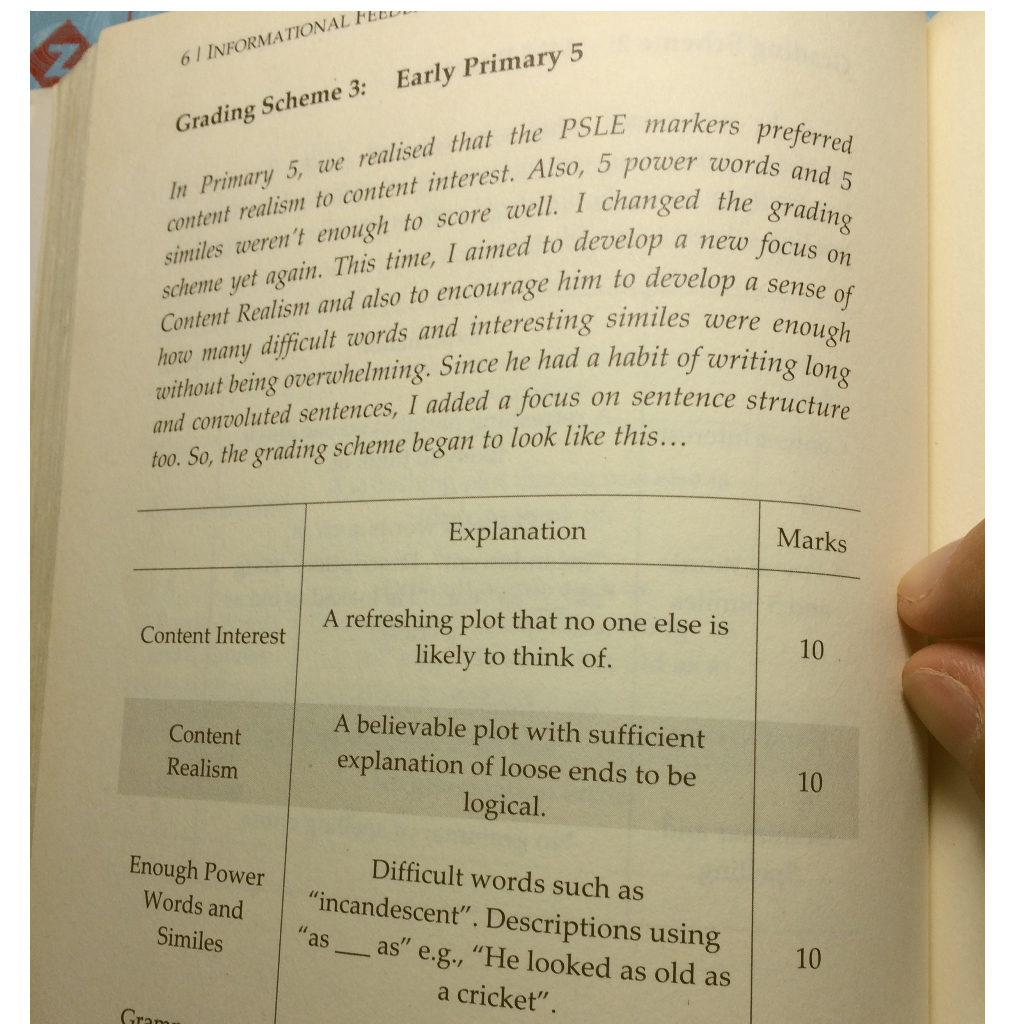
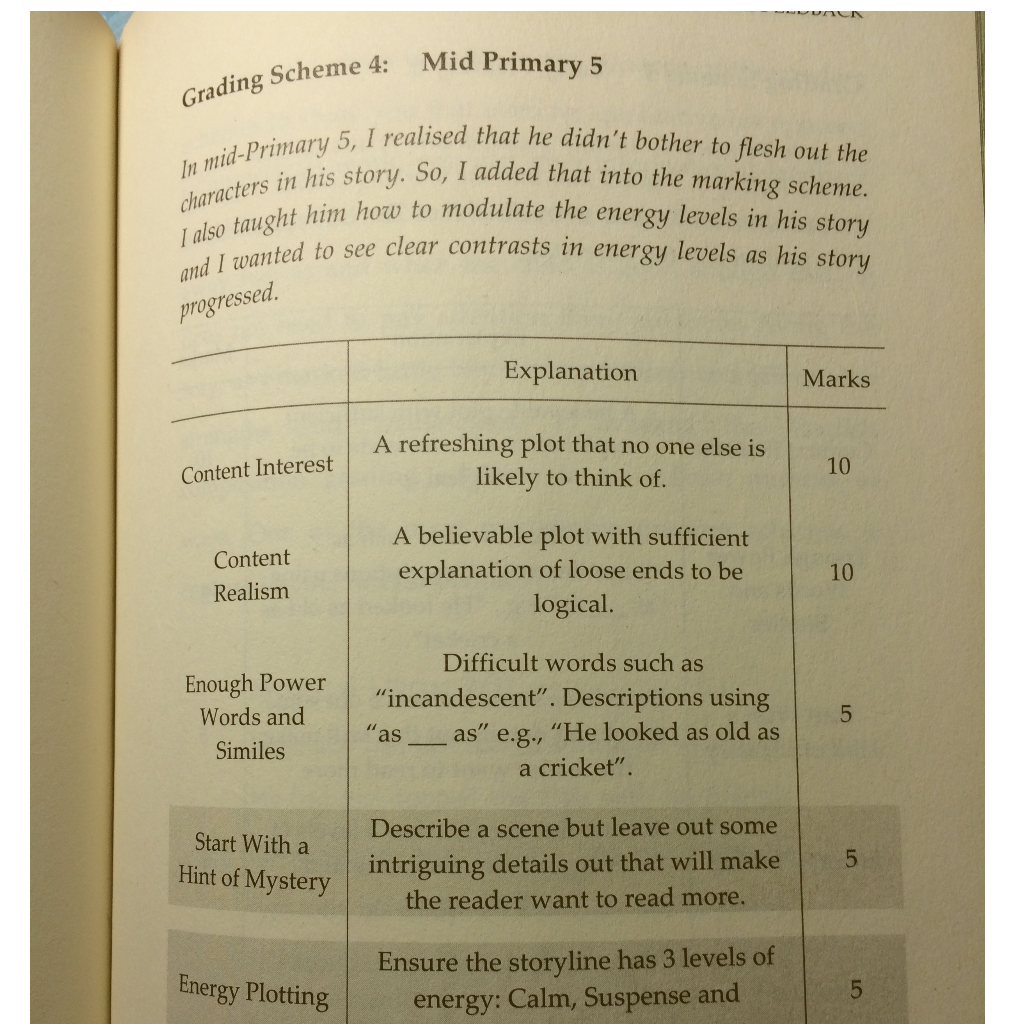
  • Informational Feedback - My key takeaway for this strategy is the way the author attempts to grade her kid's composition. We know the way to grade maths. You either get the question correct or wrong. Language is more subjective. The author provides a good framework that can be understood by the kid easily and simple for parents as well.


  • Difficult Victories - Letting the kid experiencing success that is hard to come by. Boosting his self confidence and crushing any limiting belief that he may have. Problem is how to create opportunities for him to experience such victories.
  • Emotional Connection - This is a given. Nagging is not going to work in the long run.
  • Random Intermittent Variable Reinforcements, Random Intermittent Variable Punishments - Similar to allowing kids to experience difficult victories, allowing situation to punish the kids. Let them learn from life lessons.
  • Failure Management - Shaping the kids to have learning goal orientation. A learning approach that strives to develop one's skills and abilities and not fearing to make mistakes, rather, learn and overcome mistakes.
  • Design Self Concept - This is basically about building up self esteem and self confidence.
  • Set Goals - I have questions on this. Do we only use marks for this? I am trying to not emphasise on marks to foster the learner's mindset mentioned in the earlier chapter.
  • Specify and Magnify - Basically, to notice the small good behaviours and praise in a big way.
  • Physical Movement - Children need to move around and stay active. Helps in their learning as well.
Images from book "Internal Drive Theory" by Petunia Lee.

Nov 3, 2015

Book Notes: Be So Good They Can't Ignore You by Cal Newport


Cal Newport, in his book, Be So Good They Can't Ignore You, asserts that following our passion to find a dream job and be happy is elusive. 

Instead of searching for our passion, he suggests that we should focus on building up our capability (he calls it "career capital") by capitalising on every opportunity. 

Now how should we distinguish the true opportunities? Firstly, we should pursue that that will give us more control, more control over time and over our lives. Secondly, look for pursue that that people are willing to pay us money for.

In the end, we are taking many small bets on our lives and hopefully, the big break will come. 

Mike Rowe also shared his experiences on why he think the happiest people are not the one who followed their passions.